7 Image Composition Techniques Every Content Creator Should Know
Published: July 1, 2026
For the first three years that I created visual content online, my photos were technically fine but somehow flat. The turning point came when I was shooting a flat lay of coffee accessories for a brand partnership — ceramic pour-over, linen napkin, a bag of single-origin beans. The light was perfect, soft morning sun through a north-facing window. The styling was careful. But when I posted it on Instagram next to a similar shot from a photographer I followed, mine looked like a catalog clip-art and hers looked like a magazine spread. Same objects. Same budget. Completely different feeling.
I spent the next weekend obsessively comparing my feed to hers, and the difference was not gear or editing. It was composition — where she placed things in the frame, how she let some areas breathe, how she used the edge of the table as a leading line pulling your eye toward the cup. I went back and re-shot that same flat lay with nothing but compositional changes, and the new version outperformed the original by 3x in saves. That single re-shoot changed how I think about every image I make.
Composition is not some mystical talent thing. It is a set of decisions about where to place elements, how to guide the viewer's eye, and what to leave out. Here are the seven techniques I actually use on a regular basis, with the mistakes I made learning them.
1 Rule of Thirds
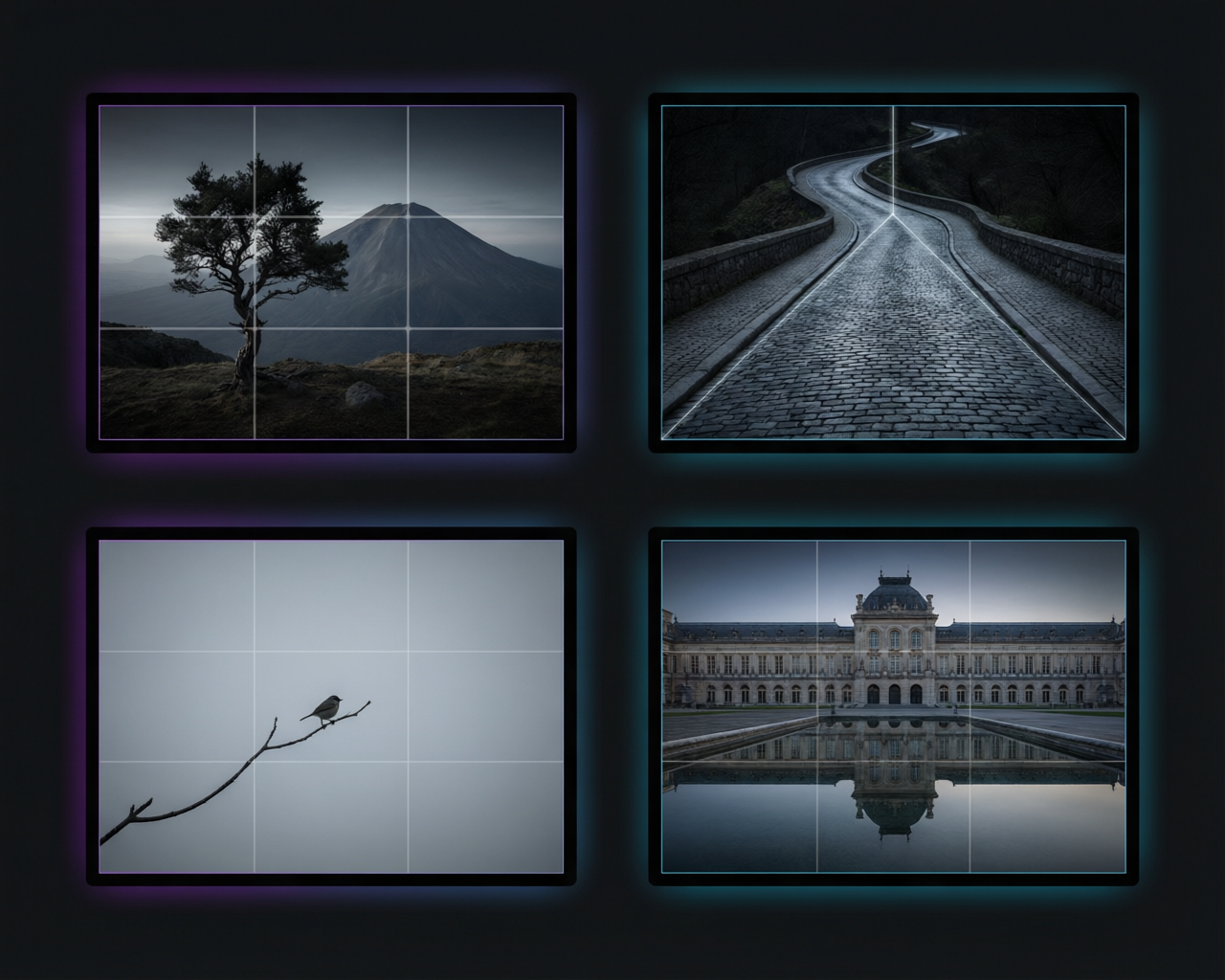
The rule of thirds sounds almost too simple to matter: imagine a three-by-three grid over your frame, and place your subject along those lines or at the intersections instead of dead center. But the first time I actually tried it, the difference was startling. I was shooting headshots for a skincare brand and had been centering every face — felt safe, felt "correct." The art director pulled me aside and said, "Move her to the right third. Let her look into space." I did, and the image went from passport photo to editorial portrait in one adjustment.
I keep the grid overlay turned on for every shoot now — camera and phone. Not because I follow it rigidly, but because it gives me a starting point. Once you internalize the grid, you start noticing when centering actually works (symmetry, for instance) versus when it is just a lazy default. I would guess 70% of my published photos use some version of thirds placement. The other 30% break it on purpose.
2 Leading Lines
Leading lines are visual paths that pull the viewer's eye through your image — roads, fences, table edges, shadows, a row of bottles on a shelf. Our eyes follow lines automatically, so a strong one essentially grabs the viewer and walks them exactly where you want them to go.
I did not appreciate how powerful this was until I shot a farmers market series for a local tourism board. The first batch was flat — straight-on shots of produce stands, perfectly lit, completely lifeless. Then I noticed the concrete pathway running between the stalls and crouched down so it stretched from the bottom corner of my frame toward a vendor in the middle distance. That single angle change made the photo feel like you were walking into the market. The client picked it as the hero image for their homepage. Now when I arrive at any location, leading lines are the first thing I scan for — usually before I even pick up the camera.
When to use it: Any time your environment has linear elements — pathways, architectural edges, shorelines, rows of anything. This is probably the technique I lean on most for landscape and travel work, but it shows up in my product photography too. The edge of a table, a stylized line of ingredients, even a shadow cast across a surface can do the job.
3 Framing Within Frames
Use elements in the foreground — doorways, windows, branches, the gap between two buildings — to create a natural border around your subject. This adds depth and blocks peripheral distractions, funneling attention right where you want it. I use this constantly for portrait-style social posts because it creates an instant feeling of intimacy, like the viewer is peeking into a moment rather than being shown a staged scene.
4 Symmetry and Patterns
There is a reason Wes Anderson frames almost every shot symmetrically — our brains find balanced, mirrored compositions deeply satisfying. Symmetry feels formal and calm. It works beautifully for architecture, reflections in still water, and straight-on portraits where the subject commands the center.
Patterns — repeating elements like a row of windows, a field of flowers, a grid of tiles — create visual rhythm. And the real trick with patterns is breaking them. One red umbrella in a sea of black ones becomes an instant focal point. I use pattern breaks constantly in flat lays: four matching items plus one oddball outperform five matching items every time in my engagement metrics.
5 Negative Space
Negative space is the empty area around your subject — the blank wall, the open sky, the stretch of water with nothing in it. I was late to this one. For years I tried to fill every corner of my frame, thinking more visual information meant more value. Then I started making blog featured images that needed text overlays, and my busy photos were a nightmare. White text on a cluttered background is unreadable no matter how much you bump the drop shadow.
Once I started leaving the top or bottom third of my images deliberately empty — just sky, just wall, just table surface — everything changed. The subject felt more important by contrast, the images looked cleaner in the feed, and the text overlays finally worked. In a social media environment where everyone is cramming as much as possible into the frame, restraint is a competitive advantage. I now think of negative space as the most underused tool in content photography. If you are making any kind of graphic that involves overlaid text, this is non-negotiable.
6 Layering and Depth
A photo is flat, but it does not have to look flat. Layering means including distinct foreground, middle ground, and background elements so the viewer's eye travels into the scene rather than sliding across it. Think: wildflowers in front, a winding path in the middle, mountains behind. Each layer adds dimension.
This applies outside landscape work too. In product photography, I place a prop slightly out of focus in the foreground, the main product sharp in the middle, and a softer background element behind. It creates the same sense of depth without needing a wide-angle lens. The key is making sure each layer has a clear tonal or textural difference from the others — if everything blurs into the same visual weight, the layers collapse.
7 Odd Numbers Rule
Three items look better than two. Five look better than four. I cannot fully explain why, but every time I style a flat lay with an even number of objects, it feels slightly "off" — like something is missing or paired too neatly. Switching to three or five elements consistently produces images that feel more natural and dynamic. This is the first thing I check when a composition feels stuck and I cannot figure out why.
Which Techniques Work Best for Which Platforms
Not every composition technique works equally well across all platforms. Here is how I match techniques to platforms based on what I have observed performing best.
Instagram: Rule of thirds, negative space, symmetry, and odd numbers all perform well. Instagram's square and vertical formats favor clean, graphic compositions that read clearly at small sizes. Busy, complex compositions with lots of layered detail tend to lose impact in the feed. Tight framing — getting close enough that the subject fills most of the image — also does well because it reads as bold even at thumbnail size. For carousels, consistency in compositional approach across slides is essential.
Twitter: Bold, simple compositions work best. Tight close-ups, strong leading lines, and high-contrast symmetry stand out in the fast-moving timeline. Subtle compositional nuances are often lost on Twitter because images are displayed relatively small and viewed quickly.
Blog featured images: Negative space is king here. Your featured image needs room for text overlay and must work as a small thumbnail. Rule of thirds compositions with the subject positioned to one side and open space on the other are the most versatile format for blog imagery.
Pinterest: Vertical formats dominate, which makes leading lines and layering particularly effective — anything that creates visual flow from top to bottom of a tall image. Pinterest users are looking for inspiration and ideas, so compositions that tell a story or show a process tend to perform well.
Common Composition Mistakes
Even after years of practice, I still catch myself making these mistakes. Some of them I catch in the moment, others only when I am editing and wondering why a shot does not feel right.
Horizons that are almost but not quite level. A slightly tilted horizon looks like a mistake. A deliberately tilted horizon looks like a creative choice. The difference is the degree of intentionality. If your horizon is in the frame, use your camera's level indicator or the grid lines to make sure it is perfectly straight, unless you are tilting it deliberately for dynamic effect.
Distracting backgrounds. A beautiful subject in front of a cluttered, busy background produces a cluttered, busy photo. Before you press the shutter, look at what is behind your subject. Can you change your angle to eliminate distractions? Can you move closer to fill the frame? Can you use a wider aperture to blur the background? The background is part of your composition whether you want it to be or not.
Subject placed dead center without intention. Centered compositions are not inherently wrong, but they should be a deliberate choice, not a default. If you center your subject, ask yourself why. Does the centered placement add to the image's meaning or mood? If not, try the rule of thirds and compare the results.
Too many competing focal points. A common beginner mistake is trying to include everything interesting in a single frame. The result is an image where the viewer does not know where to look. Good composition is as much about exclusion as inclusion. Identify the one element that matters most and build your composition around it, removing or minimizing everything else.
Ignoring the edges of the frame. Before you take a photo, scan the edges of your viewfinder. Is there a stray branch poking in from the corner? Half a person cut off at the edge? An awkward crop of a background element? These edge intrusions look sloppy and distract from your subject. Clean edges signal a considered, intentional composition.
Always shooting from eye level. This is the mistake I see most often, and I am guilty of it constantly. Most people photograph the world from where they stand, looking slightly down. Which means most photos look exactly like what everyone sees every single day. Some of my best-performing social media posts came from doing something as simple as crouching low to the ground, holding the camera above my head, or lying flat on a table to shoot a flat lay from an angle no one actually experiences. When a subject feels ordinary — food, a pet, a city street — changing your perspective is usually the fastest fix. The viewer's brain registers the unusual angle before it registers anything else about the image.
Frequently Asked Questions
What is the most important composition technique for beginners?
Rule of thirds, no contest. It is the one I wish someone had drilled into me from day one. You do not need any special gear — just turn on the grid overlay on your phone camera and start placing your subject along those lines instead of in the center. You will see a difference in your very first shoot. I would say get comfortable with thirds before you even think about the other techniques. It is that foundational.
Can I combine multiple composition techniques in one photo?
Yes, and honestly the best photos almost always do. A landscape with a leading line pulling your eye toward a subject placed on a thirds intersection, with foreground elements creating depth — that is three techniques working together and it looks completely natural. The trick is not to force it. Start with one technique until it becomes automatic, then start layering. I still mess this up sometimes by trying to cram too many compositional ideas into a single frame, and the result is always a photo that feels overthought.
Do composition rules apply to social media photos or just professional photography?
They matter more for social media, if anything. Your image is competing for attention in a feed where people are scrolling fast, and a well-composed photo stops the scroll because it looks balanced and intentional — even if the viewer cannot tell you why. The same thirds, leading lines, and negative space I use for client work are exactly what I use for my own Instagram posts. There is no separate "casual" composition for social media. Good framing is good framing.
How long does it take to develop good composition instincts?
Faster than you might think for the basics, longer than you would hope for true instinct. I noticed real improvement within the first few weeks of deliberately practicing thirds placement. But making compositional decisions without thinking about them — that took me closer to a year of regular shooting. The thing that helped most was reviewing my photos after each shoot and asking which compositions worked and why, not just snapping more and hoping for the best. I still go through phases where I get sloppy and have to re-train my eye. It is not a one-and-done skill.
Now that you know how to compose a great shot, give it the perfect frame.
Add Borders to Your Photos Free